Digital Payment Reconciliation: Save 10 Hours Monthly

Digital payment reconciliation is crucial for financial accuracy, enabling businesses to streamline accounting processes and save significant operational time, potentially up to 10 hours monthly, by automating transaction matching and reducing manual errors.
In today’s fast-paced digital economy, managing financial transactions can quickly become overwhelming. Businesses are increasingly adopting digital payments, which while convenient, introduce complex reconciliation challenges. This article explores how effective digital payment reconciliation can streamline your accounting processes, ultimately saving your business up to 10 hours per month.
Understanding digital payment reconciliation
Digital payment reconciliation is the process of matching transactions recorded in a business’s internal accounting system with those reported by payment processors, banks, and other financial institutions. This ensures that all incoming and outgoing funds are accurately accounted for, identifying any discrepancies, errors, or fraudulent activities. It’s a critical step in maintaining financial health and integrity.
The transition from cash and checks to digital payment methods has drastically changed how businesses operate. While offering unparalleled convenience and speed, digital transactions also generate a larger volume of data from various sources, making manual reconciliation a time-consuming and error-prone task. This necessitates a more sophisticated approach to ensure accuracy.
Why reconciliation matters for modern businesses
For any business, especially those handling a high volume of digital transactions, robust reconciliation processes are non-negotiable. It’s not just about balancing books; it’s about gaining deep insights into cash flow, preventing losses, and ensuring compliance. Without proper reconciliation, businesses risk misstating their financial position, leading to poor decision-making.
- Accuracy of financial records: Ensures every transaction is correctly recorded.
- Fraud detection: Helps identify unauthorized or suspicious activities promptly.
- Improved cash flow management: Provides a clear picture of available funds.
- Compliance and auditing: Simplifies audits and regulatory reporting.
Ultimately, a well-implemented digital payment reconciliation strategy transforms a traditionally tedious task into a powerful tool for financial oversight and strategic planning. It moves businesses from reactive problem-solving to proactive financial management, setting the stage for sustainable growth and efficiency.
The challenges of manual reconciliation
Historically, businesses relied on manual processes for reconciling their accounts. This often involved sifting through stacks of paper statements, comparing entries line by line in spreadsheets, and painstakingly identifying discrepancies. While this method might have been feasible for businesses with low transaction volumes, it becomes an insurmountable hurdle in the age of digital payments.
The sheer volume and variety of digital transactions — from credit card payments and mobile wallets to online transfers and subscription services — create a complex data landscape. Each payment channel often has its own reporting format, transaction fees, and settlement cycles, adding layers of complexity to the reconciliation process. This fragmentation makes manual efforts prone to human error and significant delays.
Time-consuming and error-prone nature
One of the most significant drawbacks of manual reconciliation is the time it consumes. Accounting teams can spend countless hours each month downloading statements, entering data, and cross-referencing entries. This time could be better spent on strategic financial analysis or other value-adding activities. Moreover, the repetitive nature of manual data entry significantly increases the risk of errors, which can have cascading effects on financial statements and operational decisions.
- High labor costs: Requires dedicated staff hours for a repetitive task.
- Increased error rates: Human mistakes in data entry or matching are common.
- Delayed financial reporting: Reconciliation backlog postpones critical financial insights.
- Difficulty in scaling: Manual processes cannot keep pace with business growth.
The challenges of manual reconciliation extend beyond just time and errors; they also impact a business’s ability to scale efficiently. As transaction volumes grow, the manual workload increases proportionally, leading to bottlenecks and stifling expansion. This highlights the urgent need for automated solutions that can handle the modern pace of digital commerce.
Automating digital payment reconciliation
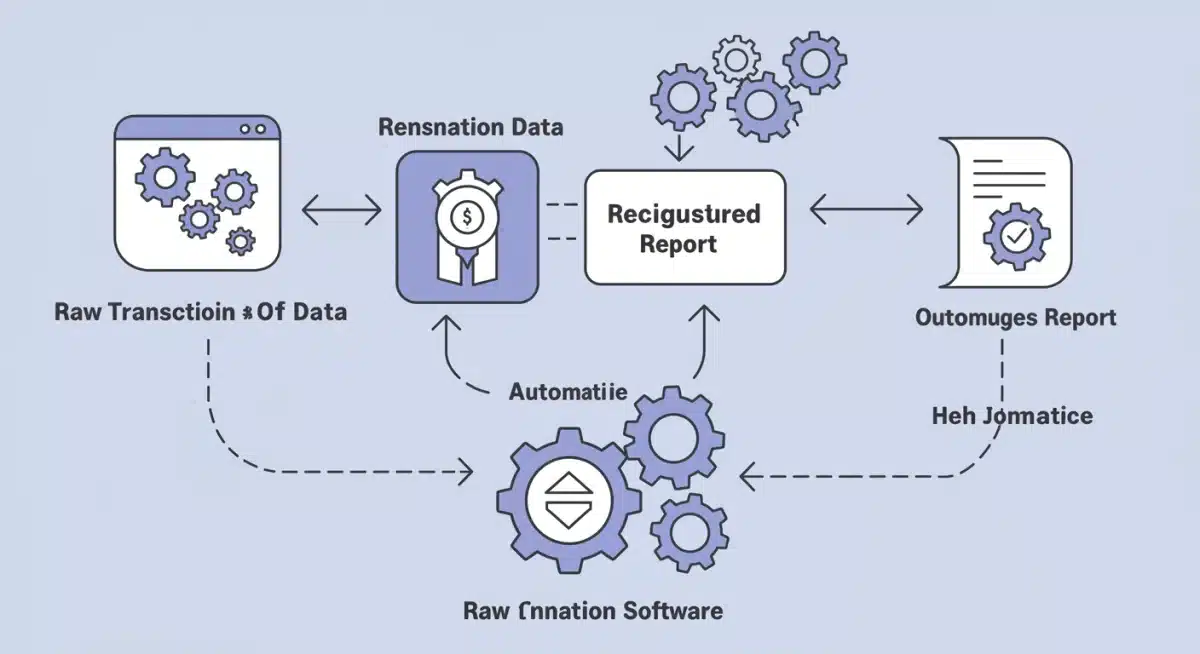
The solution to the inherent challenges of manual reconciliation lies in automation. Automating digital payment reconciliation involves leveraging specialized software and tools to automatically collect, process, and match transaction data from various sources. This technological shift not only mitigates errors but also dramatically reduces the time spent on this critical accounting function.
Modern reconciliation software integrates directly with payment gateways, banks, and accounting systems, pulling data in real-time or at scheduled intervals. It then applies predefined rules and algorithms to match transactions, identify discrepancies, and generate detailed reports. This seamless flow of information ensures that financial records are always up-to-date and accurate, providing a single source of truth for all financial activities.

Key features of effective reconciliation software
Choosing the right reconciliation software is crucial for maximizing efficiency gains. The best solutions offer a range of features designed to handle the complexities of digital payments. These features simplify the process, making it accessible even for teams without extensive technical expertise, and ensure that all financial data is meticulously managed.
- Multi-source data integration: Connects to various payment processors, banks, and ERP systems.
- Automated matching rules: Customizable rules for matching transactions based on specific criteria.
- Discrepancy identification: Flags unmatched transactions or variations for review.
- Reporting and analytics: Provides insights into payment trends and reconciliation status.
By implementing automated digital payment reconciliation, businesses can move away from reactive problem-solving to proactive financial management. This allows accounting professionals to focus on higher-value tasks, contributing more significantly to the business’s strategic objectives and overall financial health. The investment in such technology pays dividends in terms of time saved, error reduction, and enhanced financial clarity.
Saving 10 hours per month: a tangible benefit
The promise of saving 10 hours per month through automated digital payment reconciliation is not an exaggeration; it’s a realistic and achievable goal for many businesses. This time saving translates directly into reduced operational costs and increased productivity, allowing accounting teams to reallocate their efforts to more strategic tasks that drive business growth.
Consider a scenario where an accounting team spends a significant portion of their week on manual data entry and cross-referencing. By automating these repetitive tasks, the software can complete them in a fraction of the time, freeing up valuable employee hours. These hours can then be dedicated to financial analysis, forecasting, budgeting, or even process improvement initiatives, ultimately transforming the role of the accounting department from transactional to strategic.
Real-world impact on productivity and cost
The impact of this time saving extends beyond just the accounting department. More accurate and timely financial data supports better decision-making across the entire organization. Sales teams can access up-to-date revenue figures, marketing can optimize campaigns based on real-time spending, and leadership can make informed strategic choices with confidence.
- Reduced labor costs: Less time spent on manual tasks means lower operational expenses.
- Increased accuracy: Fewer errors lead to fewer financial adjustments and corrections.
- Faster financial close: Expedites month-end and year-end closing processes.
- Enhanced employee satisfaction: Reduces tedious work, allowing staff to focus on engaging tasks.
Ultimately, the 10 hours saved each month represents a significant return on investment for businesses adopting automated digital payment reconciliation. It’s a clear demonstration of how technology can optimize core business functions, leading to improved efficiency, greater financial control, and a more agile response to market dynamics.
Best practices for effective reconciliation
While automation is a powerful tool, its effectiveness is amplified when paired with established best practices for digital payment reconciliation. Implementing a comprehensive strategy ensures that the technology is utilized to its full potential, leading to sustained accuracy and efficiency in your financial operations. These practices serve as a framework for optimizing the entire reconciliation workflow.
One critical best practice is to establish clear and consistent naming conventions for all transactions and accounts. This standardization simplifies the automated matching process and reduces the likelihood of false negatives or positives. Additionally, regular review of reconciliation reports is essential, even with automation, to catch any unusual patterns or discrepancies that might indicate underlying issues.
Implementing a robust reconciliation strategy
A successful reconciliation strategy goes beyond just software; it involves people and processes. Training staff on the new automated systems, defining clear roles and responsibilities, and setting up a schedule for regular reconciliation checks are all vital components. Continuous monitoring and adaptation of rules are also necessary as payment methods evolve or business needs change.
- Standardize data inputs: Ensure consistent formatting across all payment sources.
- Regularly review unmatched items: Investigate discrepancies promptly to prevent accumulation.
- Automate as much as possible: Leverage software features to minimize manual intervention.
- Implement strong internal controls: Segregate duties to prevent fraud and errors.
By adhering to these best practices, businesses can maximize the benefits of digital payment reconciliation, ensuring not only financial accuracy but also operational resilience. It transforms reconciliation from a necessary evil into a strategic asset, empowering businesses with clear financial visibility and control.
Choosing the right reconciliation solution
Selecting the appropriate digital payment reconciliation solution is a pivotal decision for any business aiming to enhance its financial processes. The market offers a wide array of software options, each with varying features, scalability, and integration capabilities. The key is to identify a solution that aligns perfectly with your business’s specific needs, transaction volume, and existing technological infrastructure.
Begin by assessing your current reconciliation challenges and identifying the most pressing pain points. Are you struggling with high transaction volumes, multiple payment gateways, or complex fee structures? Understanding these specific hurdles will guide you toward a solution designed to address them effectively. Consider factors like ease of integration with your existing accounting software, the level of customization offered, and the quality of customer support.
Factors to consider for optimal selection
Beyond immediate needs, think about the future scalability of the solution. As your business grows, will the software be able to handle increased transaction volumes and potentially new payment channels? A flexible and scalable solution will prevent the need for costly migrations down the line. Also, pay close attention to security features, as you’ll be handling sensitive financial data.
- Integration capabilities: Compatibility with existing accounting systems and payment gateways.
- Scalability: Ability to handle increasing transaction volumes as your business grows.
- Customization options: Flexibility to set up specific matching rules and reporting formats.
- User-friendliness: Intuitive interface for easy adoption by your accounting team.
Ultimately, the right digital payment reconciliation solution acts as a strategic partner, not just a tool. It should empower your business to achieve greater financial accuracy, efficiency, and control, paving the way for sustained success in the evolving landscape of digital commerce. Investing time in this selection process will yield significant long-term benefits.
Future trends in digital payment reconciliation
The landscape of digital payments is continuously evolving, and with it, the methods and technologies for reconciliation. Staying abreast of emerging trends is crucial for businesses looking to maintain a competitive edge and ensure their financial processes remain efficient and secure. The future of digital payment reconciliation promises even greater automation, intelligence, and integration.
One significant trend is the increasing adoption of artificial intelligence (AI) and machine learning (ML) in reconciliation software. These advanced technologies can learn from historical data to identify complex matching patterns, predict potential discrepancies, and even suggest corrective actions. This moves reconciliation beyond simple rule-based matching to a more intelligent, predictive approach, further reducing manual intervention.
Emerging technologies and their impact
Blockchain technology is another area poised to revolutionize reconciliation. By providing an immutable and transparent ledger of all transactions, blockchain could potentially eliminate the need for traditional reconciliation processes altogether, as all parties would have access to the same verified data in real-time. While still in its early stages for widespread adoption in this context, its potential is undeniable.
- AI and machine learning: For intelligent matching, anomaly detection, and predictive analysis.
- Real-time reconciliation: Moving from batch processing to continuous, immediate matching.
- API-first integration: Seamless connectivity with a broader ecosystem of financial tools.
- Enhanced data analytics: Deeper insights into payment behavior and financial health.
These future trends indicate a move towards fully autonomous and highly intelligent reconciliation systems that will not only save more time but also provide unprecedented levels of financial insight and control. Businesses that embrace these advancements will be well-positioned to navigate the complexities of the digital economy with greater agility and confidence.
| Key Aspect | Brief Description |
|---|---|
| Core Purpose | Matching internal records with external statements to ensure financial accuracy. |
| Time Savings | Automation can save businesses up to 10 hours per month on accounting tasks. |
| Key Benefit | Improved financial accuracy, fraud detection, and better cash flow management. |
| Future Outlook | AI, machine learning, and blockchain promise enhanced automation and intelligence. |
Frequently asked questions about digital payment reconciliation
Digital payment reconciliation is the process of matching a business’s internal transaction records with those reported by financial institutions. It’s crucial for ensuring financial accuracy, detecting fraud, managing cash flow effectively, and complying with regulatory requirements, providing a true picture of a company’s financial health.
Automation software streamlines data collection, matching, and discrepancy identification, eliminating manual data entry and cross-referencing. This reduces the time spent on repetitive tasks, freeing up valuable accounting hours for more strategic analysis and business development, often totaling 10 hours or more monthly.
Businesses with high transaction volumes, multiple payment channels (e.g., e-commerce, retail, SaaS), or those experiencing rapid growth benefit most. Any business looking to reduce manual errors, improve financial reporting speed, and gain better control over their cash flow will see significant advantages.
Look for robust integration capabilities with your existing systems, customizable automated matching rules, efficient discrepancy identification and resolution tools, and comprehensive reporting features. User-friendliness and scalability are also crucial for long-term success and adoption within your team.
By systematically matching every transaction, reconciliation makes it easier to spot unusual or unauthorized activities that might otherwise go unnoticed. Automated systems can flag suspicious patterns or unmatched transactions instantly, allowing for quicker investigation and mitigation of potential fraudulent losses.
Conclusion
The journey towards efficient financial management in the digital age inevitably leads to the adoption of advanced reconciliation practices. As digital payments continue to dominate, businesses can no longer afford the inefficiencies and inaccuracies inherent in manual reconciliation. Embracing automated digital payment reconciliation is not merely an operational upgrade; it’s a strategic imperative that promises tangible benefits, including significant time savings, enhanced accuracy, and a clearer financial picture. By streamlining these critical accounting processes, businesses can redirect valuable resources towards growth and innovation, ultimately securing a more robust and sustainable financial future. The path to saving 10 hours per month and beyond is clear: embrace intelligent automation and transform your financial operations.