U.S. Supply Chain Resilience: 25% Disruption Reduction by 2025

U.S. companies are actively deploying advanced supply chain resilience strategies to cut disruptions by 25% by 2025, focusing on diversification, technology adoption, and robust risk management frameworks.
The landscape of global commerce has irrevocably shifted, making supply chain resilience strategies not just beneficial, but absolutely critical for U.S. companies aiming to navigate an unpredictable future. With a collective goal of reducing disruptions by 25% by 2025, businesses are proactively implementing innovative approaches to fortify their operations against unforeseen challenges. This article delves into the insider knowledge and practical solutions driving this transformative push.
Understanding the Imperative for Resilience
The past few years have laid bare the vulnerabilities inherent in global supply chains, from geopolitical tensions and natural disasters to pandemics and cyberattacks. These events have not only caused significant financial losses but also eroded consumer trust and market share. For U.S. companies, the urgency to build robust and adaptable supply chains has never been greater, moving beyond mere efficiency to embrace true resilience.
Resilience in this context means the capacity to anticipate, absorb, and adapt to disruptions, ultimately recovering quickly and efficiently. It’s about creating systems that are not just strong, but also flexible and intelligent, capable of self-correction and continuous improvement. This strategic shift is a direct response to a recognition that a ‘business as usual’ approach is no longer sustainable in a world characterized by constant change and increasing complexity.
The Economic Impact of Supply Chain Disruptions
Disruptions carry a hefty price tag, impacting everything from production schedules and inventory levels to customer satisfaction and brand reputation. Studies consistently show that companies with more resilient supply chains outperform their peers during crises, demonstrating the clear economic benefits of proactive investment. This understanding is fueling the aggressive targets set for 2025, pushing companies to rethink their entire operational framework.
- Loss of Revenue: Businesses face direct revenue loss due to delayed shipments or inability to meet demand.
- Increased Costs: Expedited shipping, alternative sourcing, and idle production lines drive up operational expenses.
- Brand Damage: Failed deliveries and product shortages can severely damage brand loyalty and public perception.
- Market Share Erosion: Competitors with more robust supply chains can capitalize on vulnerabilities, leading to lost market share.
Ultimately, the drive for supply chain resilience is a strategic imperative designed to safeguard future profitability and ensure long-term competitiveness. It’s about building a foundation that can withstand shocks and emerge stronger, rather than simply reacting to crises as they unfold.
Diversifying Sourcing and Manufacturing Footprints
One of the most impactful strategies U.S. companies are employing to enhance supply chain resilience is the aggressive diversification of their sourcing and manufacturing locations. The over-reliance on single regions or suppliers proved catastrophic during recent global events, prompting a significant re-evaluation of geographical risk.
This diversification isn’t merely about adding more suppliers; it’s about strategically placing production and sourcing across different geopolitical and geographical zones to minimize exposure to localized disruptions. Companies are exploring ‘friend-shoring’ and ‘near-shoring’ initiatives, bringing production closer to home or to allied nations, thereby reducing lead times and transportation risks. This approach fosters a more distributed and less fragile network, ensuring that a problem in one area doesn’t cripple the entire operation.
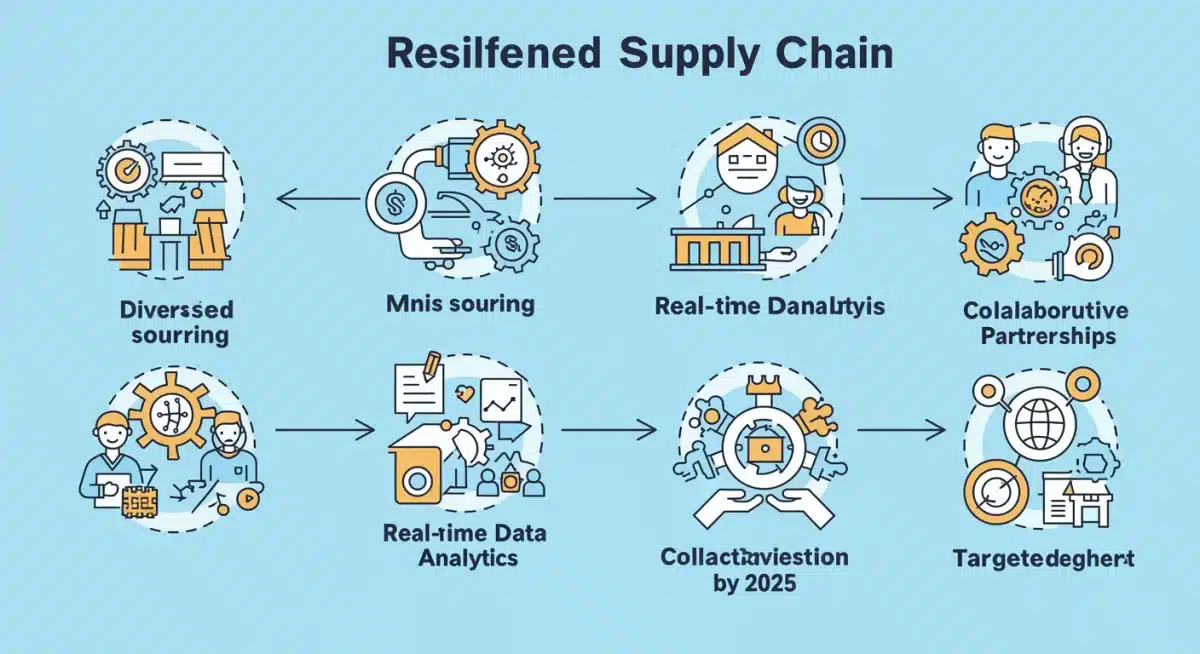
The goal is to move away from a purely cost-driven model to one that balances cost-efficiency with risk mitigation. This involves a thorough analysis of potential points of failure and proactively building redundancies into the system. It’s a complex undertaking that requires significant investment but promises substantial returns in stability and operational continuity.
Building a Network of Redundant Suppliers
Beyond geographical diversification, companies are also focusing on building relationships with multiple qualified suppliers for critical components and materials. This creates a safety net, ensuring that if one supplier falters, others can step in to fill the void. This strategy requires meticulous vetting and ongoing relationship management to ensure reliability and quality across the entire supplier base.
- Primary and Secondary Sourcing: Establishing clear primary and backup suppliers for all essential inputs.
- Regional Hubs: Creating regional manufacturing or distribution hubs to serve specific markets, reducing reliance on central facilities.
- Strategic Partnerships: Forming long-term alliances with key suppliers to foster mutual investment in resilience.
- Local Production Incentives: Leveraging government incentives and tax breaks for domestic manufacturing to reduce international dependencies.
By consciously moving away from single points of failure, companies are constructing a more robust and adaptable supply chain capable of withstanding a wider range of external shocks. This strategic shift is fundamental to achieving the ambitious disruption reduction targets.
Leveraging Technology for Enhanced Visibility and Agility
Technology is undeniably at the forefront of the movement towards greater supply chain resilience. U.S. companies are heavily investing in digital tools and platforms that offer unprecedented visibility, predictive analytics, and automated response capabilities. These technologies transform static supply chains into dynamic, intelligent networks capable of real-time adaptation.
From advanced IoT sensors tracking shipments in real-time to AI-powered predictive models forecasting potential disruptions, the integration of technology is creating a more transparent and agile operational environment. This enhanced visibility allows companies to identify bottlenecks before they become critical issues and to react swiftly when disruptions do occur, minimizing their impact.
Implementing Advanced Analytics and AI
The ability to collect and analyze vast amounts of data is a game-changer. AI and machine learning algorithms can sift through complex datasets, identifying patterns and anomalies that human analysis might miss. This leads to more accurate demand forecasting, optimized inventory management, and proactive risk assessment.
- Predictive Maintenance: Using data to anticipate equipment failures in manufacturing and logistics.
- Demand Sensing: AI-driven tools that analyze market trends and consumer behavior for more accurate demand forecasts.
- Route Optimization: Dynamic routing solutions that adapt to real-time traffic, weather, or geopolitical events.
- Risk Scoring: Algorithms that assess supplier risk based on various factors, including financial health and geopolitical stability.
Ultimately, technology empowers companies to move from a reactive stance to a proactive one, enabling them to anticipate and mitigate risks before they escalate. This digital transformation is a cornerstone of achieving significant reductions in supply chain disruptions.
Strengthening Collaboration and Information Sharing
A resilient supply chain is not built in isolation; it thrives on collaboration and open information sharing across all stakeholders. U.S. companies are increasingly recognizing the value of forging stronger, more transparent relationships with their suppliers, logistics partners, and even customers. This collaborative approach creates a shared ecosystem where risks are identified collectively and solutions are co-created.
Establishing clear communication channels and data-sharing protocols ensures that all parties have access to critical information in real-time. This includes everything from inventory levels and production schedules to potential delays and alternative routes. When information flows freely, decisions can be made more quickly and effectively, preventing minor issues from snowballing into major disruptions.
Building Trust-Based Partnerships
Beyond transactional relationships, the focus is shifting towards building trust-based partnerships. This involves joint planning, shared investments in technology, and a mutual commitment to resilience. Such partnerships are characterized by transparency and a willingness to support each other through challenging times.
- Joint Planning Sessions: Regular meetings with key partners to discuss future demand, potential risks, and mitigation strategies.
- Shared Platforms: Implementing common digital platforms for real-time data exchange and collaborative problem-solving.
- Performance Metrics: Developing shared key performance indicators (KPIs) that include resilience metrics, not just cost and efficiency.
- Emergency Protocols: Establishing clear, pre-defined protocols for communication and action during disruptions.
By fostering a culture of collaboration and transparency, companies can create a more interconnected and responsive supply chain network, significantly boosting its overall resilience against unforeseen challenges.
Building Robust Risk Management Frameworks
Effective supply chain resilience requires a comprehensive and proactive risk management framework. U.S. companies are moving beyond simple risk identification to developing sophisticated systems for continuous monitoring, assessment, and mitigation. This involves embedding risk considerations into every stage of the supply chain lifecycle, from design to delivery.
A robust framework includes identifying potential risks, assessing their likelihood and impact, developing contingency plans, and regularly testing these plans. It’s a dynamic process that evolves with the changing global landscape, ensuring that the supply chain remains prepared for a wide array of potential disruptions. This proactive stance is essential for meeting the 2025 disruption reduction targets.
Developing Comprehensive Contingency Plans
Contingency planning is not a one-time exercise but an ongoing process of scenario planning and readiness testing. Companies are creating detailed playbooks for various disruption scenarios, outlining specific actions, responsible parties, and communication strategies.
- Scenario Planning: Regularly simulating various disruption scenarios (e.g., port closures, factory fires, cyberattacks) to test response capabilities.
- Backup Infrastructure: Investing in redundant IT systems, alternative transportation modes, and emergency inventory storage.
- Cross-Functional Teams: Establishing dedicated teams responsible for monitoring risks and coordinating responses across departments.
- Supplier Resilience Audits: Regularly auditing key suppliers for their own risk management capabilities and business continuity plans.
By systematically identifying and preparing for potential risks, companies can significantly reduce the severity and duration of disruptions, thereby enhancing the overall resilience of their supply chains.
Investing in Workforce Training and Digital Literacy
While technology and processes are crucial, the human element remains paramount in building a resilient supply chain. U.S. companies are increasingly investing in training their workforce to adapt to new technologies, understand complex data, and make agile decisions under pressure. Digital literacy and critical thinking skills are becoming non-negotiable for supply chain professionals.
This investment extends beyond basic training, encompassing continuous learning programs, cross-functional skill development, and fostering a culture of innovation. A well-trained and empowered workforce can leverage advanced tools effectively, identify emerging risks, and implement solutions with speed and precision. This human capital development is a key enabler for achieving and sustaining supply chain resilience.
Cultivating an Adaptive Mindset
Beyond technical skills, companies are also focusing on cultivating an adaptive mindset within their teams. This involves encouraging flexibility, problem-solving, and a willingness to embrace change. In a constantly evolving environment, the ability to pivot quickly and creatively is a significant asset.
- Continuous Learning Platforms: Providing access to online courses and certifications in supply chain technology and risk management.
- Cross-Training Programs: Equipping employees with skills across different functions to increase flexibility and redundancy within teams.
- Leadership Development: Training leaders to manage uncertainty, inspire adaptability, and communicate effectively during crises.
- Simulation Exercises: Conducting regular drills and simulations to prepare teams for real-world disruption scenarios.
By investing in their people, U.S. companies are building a more intelligent, adaptable, and ultimately more resilient supply chain workforce, capable of navigating the complexities of modern global commerce.
| Key Strategy | Brief Description |
|---|---|
| Diversified Sourcing | Reducing reliance on single regions or suppliers by expanding geographical and vendor base. |
| Technology Integration | Leveraging AI, IoT, and data analytics for real-time visibility and predictive capabilities. |
| Enhanced Collaboration | Fostering transparent partnerships and information sharing with all supply chain stakeholders. |
| Risk Management Frameworks | Implementing proactive systems for continuous risk monitoring, assessment, and contingency planning. |
Frequently Asked Questions About Supply Chain Resilience
Supply chain resilience refers to a system’s ability to anticipate, withstand, and recover from disruptions effectively. It involves strategic planning, diversified resources, and adaptive mechanisms to ensure continuous operation and minimal impact from unforeseen events, safeguarding business continuity.
Recent global events like pandemics, geopolitical tensions, and natural disasters have exposed significant vulnerabilities. U.S. companies are now prioritizing resilience to mitigate financial losses, protect market share, and maintain customer trust in an increasingly unstable global environment.
Technology, including AI, IoT, and advanced analytics, provides real-time visibility into operations, enables predictive risk assessment, and automates responses to disruptions. This allows companies to make data-driven decisions and adapt quickly, significantly reducing the impact of unforeseen events.
Diversification involves spreading sourcing and manufacturing across multiple regions and suppliers. This strategy reduces reliance on single points of failure, ensuring that localized disruptions in one area do not cripple the entire supply chain, thus enhancing overall stability and adaptability.
By 2025, U.S. companies aim to reduce supply chain disruptions by 25%. This ambitious goal is being pursued through a combination of strategic investments in technology, diversified sourcing, enhanced collaboration, robust risk management, and workforce development initiatives.
Conclusion
The journey towards achieving a 25% reduction in supply chain disruptions by 2025 is an ambitious yet attainable goal for U.S. companies. By strategically investing in diversified sourcing, leveraging cutting-edge technologies, fostering deeper collaboration, and establishing comprehensive risk management frameworks, businesses are not merely reacting to past crises but proactively building a future of operational stability. The commitment to developing a digitally literate and adaptable workforce further strengthens this foundation, ensuring that the supply chains of tomorrow are not only efficient but truly resilient, capable of thriving amidst continuous global change. This integrated approach signifies a profound transformation in how American businesses perceive and manage their critical operational backbone.