Risk Mitigation Strategies for U.S. Businesses: 20% Exposure Reduction

Effective risk mitigation strategies are crucial for U.S. businesses to navigate complex challenges, aiming for a significant 20% reduction in exposure within six months through proactive, practical solutions and robust planning.
In today’s dynamic economic landscape, U.S. businesses face an array of uncertainties. Implementing robust US Business Risk Mitigation strategies is not merely advisable but essential for sustained growth and survival. This guide outlines practical, time-sensitive solutions designed to help your enterprise reduce its overall exposure by a significant 20% within the next six months.
Understanding the modern risk landscape
The modern business environment is characterized by unprecedented volatility, uncertainty, complexity, and ambiguity (VUCA). For U.S. businesses, this means navigating not only traditional market fluctuations but also emerging threats from cybersecurity, geopolitical shifts, and rapid technological advancements. A comprehensive understanding of this evolving risk landscape is the first step toward effective mitigation.
Identifying potential risks requires a proactive and systematic approach. This involves continuous monitoring of both internal operations and external market forces. Businesses must move beyond reactive measures and cultivate a culture of foresight, anticipating challenges before they escalate into crises. The goal is to build resilience into the very fabric of the organization.
Key risk categories for U.S. businesses
- Operational risks: Disruptions to daily business processes, including supply chain failures, system outages, and human error.
- Financial risks: Market volatility, credit risks, liquidity issues, and interest rate fluctuations impacting profitability.
- Strategic risks: Poor business decisions, competitive pressures, and failure to adapt to market changes.
- Compliance and regulatory risks: Non-adherence to laws, regulations, and industry standards, leading to fines or legal action.
- Cybersecurity risks: Data breaches, ransomware attacks, and intellectual property theft posing significant threats to data integrity and customer trust.
By categorizing risks, businesses can better allocate resources and develop targeted mitigation strategies. This framework allows for a more structured approach to risk assessment, ensuring that no critical area is overlooked. Understanding these categories is fundamental to developing a robust risk management plan that can withstand unforeseen challenges.
Ultimately, a deep dive into the modern risk landscape empowers U.S. businesses to transform potential threats into opportunities for strategic advantage. It’s about building a robust infrastructure that not only protects assets but also fosters innovation and adaptability in the face of continuous change.
Developing a robust risk assessment framework
A structured risk assessment framework is the cornerstone of any effective risk mitigation strategy. It involves systematically identifying, analyzing, and evaluating potential risks to your business operations. This process should be dynamic and iterative, allowing for continuous refinement as new information becomes available and the risk landscape evolves.
Start by clearly defining the scope of your assessment, considering all critical business functions, assets, and processes. Engage stakeholders from various departments to gain diverse perspectives on potential vulnerabilities. This collaborative approach ensures a more holistic and accurate risk profile for your organization.
Implementing quantitative and qualitative analysis
Risk assessment typically involves both quantitative and qualitative methods. Quantitative analysis assigns numerical values to risks, allowing for statistical modeling and cost-benefit analysis. This can include calculating the probability of a risk event occurring and its potential financial impact.
Qualitative analysis, on the other hand, focuses on descriptive evaluations, often using scales like high, medium, or low for likelihood and impact. This method is particularly useful for risks that are difficult to quantify, such as reputational damage or regulatory changes. Combining both approaches provides a comprehensive view of your risk exposure.
- Identify risks: Brainstorm potential threats through workshops, interviews, and historical data analysis.
- Analyze likelihood: Determine the probability of each identified risk occurring based on available data and expert judgment.
- Assess impact: Evaluate the potential consequences of each risk, including financial, operational, and reputational damage.
- Prioritize risks: Rank risks based on their likelihood and impact to focus mitigation efforts on the most critical threats.
Once risks are identified and analyzed, they must be rigorously evaluated against the organization’s risk appetite and tolerance levels. This evaluation helps determine which risks require immediate attention and which can be monitored. A clear understanding of acceptable risk levels guides the development of appropriate mitigation responses.
The output of a robust risk assessment framework is a prioritized list of risks, complete with detailed analyses of their potential impact and likelihood. This actionable intelligence serves as the foundation for developing and implementing targeted mitigation strategies, ensuring that resources are allocated efficiently to protect the business.
Enhancing cybersecurity defenses for data protection
In an increasingly digital world, cybersecurity risks pose one of the most significant threats to U.S. businesses. Data breaches, ransomware attacks, and intellectual property theft can lead to severe financial losses, reputational damage, and legal liabilities. Enhancing cybersecurity defenses is paramount for protecting sensitive information and maintaining customer trust.
A layered security approach is essential, combining technological solutions with robust policies and employee training. It’s not enough to simply install antivirus software; businesses must implement comprehensive security frameworks that cover all potential entry points for cyber threats.
Implementing multi-factor authentication and encryption
Multi-factor authentication (MFA) adds an extra layer of security by requiring users to provide two or more verification factors to gain access to an account. This significantly reduces the risk of unauthorized access, even if passwords are compromised. Encryption, meanwhile, protects data both in transit and at rest, rendering it unreadable to unauthorized parties.
- Adopt MFA: Implement multi-factor authentication for all critical systems and applications.
- Encrypt sensitive data: Ensure all sensitive data, both in storage and during transmission, is properly encrypted.
- Regular security audits: Conduct frequent penetration testing and vulnerability assessments to identify and address weaknesses.
- Employee training: Educate employees on phishing scams, social engineering tactics, and best practices for data security.
Beyond these technical measures, developing a strong cybersecurity culture within the organization is crucial. Employees are often the first line of defense against cyber threats; therefore, regular training and awareness programs are vital. These programs should cover topics such as identifying suspicious emails, creating strong passwords, and reporting potential security incidents.
A well-defined incident response plan is also critical. This plan should outline the steps to be taken in the event of a cyberattack, including containment, eradication, recovery, and post-incident analysis. By having a clear plan in place, businesses can minimize the impact of a breach and restore operations quickly.
By proactively enhancing cybersecurity defenses, U.S. businesses can significantly reduce their exposure to digital threats. This not only protects valuable data and assets but also reinforces customer confidence and ensures compliance with data protection regulations.
Strengthening supply chain resilience
The COVID-19 pandemic highlighted the fragility of global supply chains, revealing how quickly disruptions can cascade across industries. For U.S. businesses, strengthening supply chain resilience is no longer an option but a strategic imperative. This involves identifying vulnerabilities, diversifying suppliers, and building robust contingency plans.
A resilient supply chain is one that can withstand unforeseen shocks, adapt to changing conditions, and recover quickly from disruptions. This requires a holistic approach that considers every stage of the supply chain, from raw material sourcing to final product delivery.
Diversification and localization strategies
Relying on a single supplier or a concentrated geographic region can expose businesses to significant risks. Diversifying the supplier base across different regions and even countries can mitigate the impact of localized disruptions. Additionally, exploring opportunities for localized sourcing can reduce lead times and transportation costs, while also fostering stronger community ties.
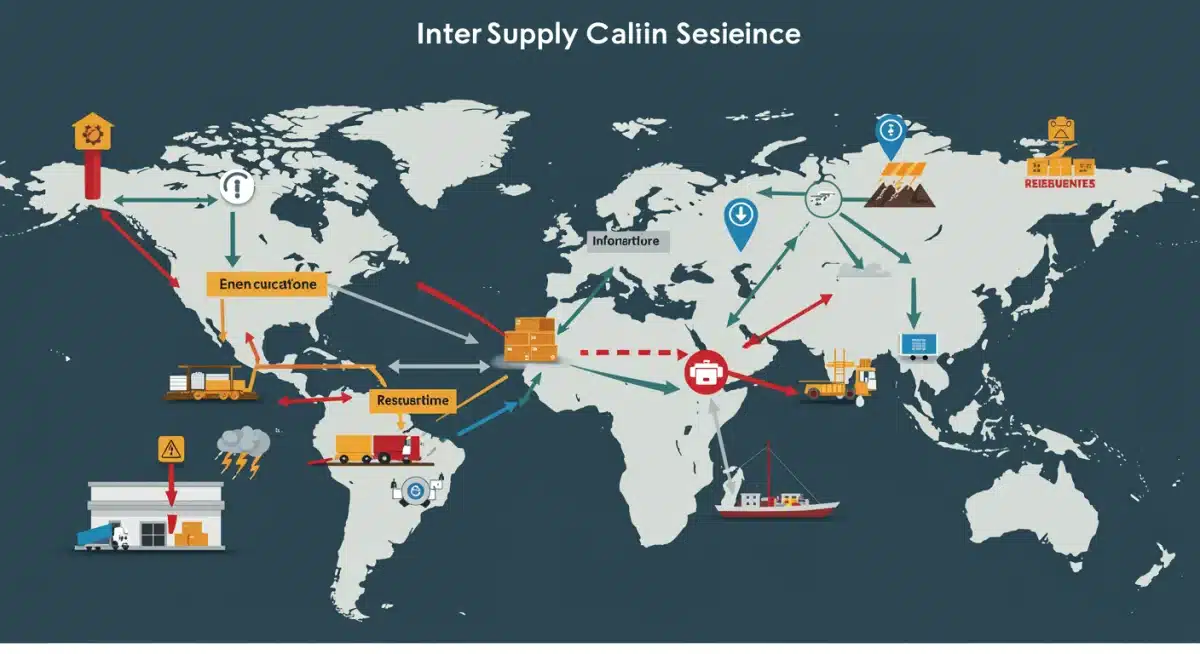
- Map your supply chain: Gain a clear understanding of all suppliers, sub-suppliers, and logistical routes.
- Diversify suppliers: Reduce reliance on single sources by engaging multiple vendors for critical components or services.
- Build inventory buffers: Maintain strategic levels of critical inventory to absorb short-term supply shocks.
- Develop contingency plans: Create detailed plans for alternative sourcing, production, and distribution in case of disruptions.
Technology plays a crucial role in enhancing supply chain visibility and resilience. Implementing advanced analytics and real-time tracking systems can provide early warnings of potential disruptions, allowing businesses to react proactively. Predictive analytics can also help forecast demand fluctuations and potential bottlenecks.
Furthermore, fostering strong relationships with key suppliers is vital. Collaborative planning, transparent communication, and shared risk management strategies can create a more robust and responsive supply chain ecosystem. These partnerships can be instrumental in navigating complex challenges and ensuring business continuity.
By proactively strengthening supply chain resilience, U.S. businesses can minimize the impact of disruptions, ensure operational continuity, and maintain a competitive edge in an increasingly interconnected global market.
Implementing comprehensive insurance and legal safeguards
Even with the most rigorous risk mitigation strategies in place, some risks are unavoidable. This is where comprehensive insurance coverage and robust legal safeguards become indispensable. These measures act as a critical safety net, protecting your business from the financial fallout of unforeseen events and legal challenges.
It’s crucial to regularly review and update your insurance policies to ensure they adequately cover all potential risks, including emerging threats. Underinsurance can be as detrimental as having no insurance at all, leaving your business vulnerable when a crisis hits.
Tailoring insurance policies to specific risks
Standard business insurance policies may not cover all the unique risks your company faces. Consider specific coverages such as cyber liability insurance, product liability insurance, professional indemnity insurance, and business interruption insurance. Each policy should be tailored to address the particular vulnerabilities of your industry and operations.
Legal safeguards, including well-drafted contracts, robust privacy policies, and compliance frameworks, are equally important. These measures help minimize legal exposure, protect intellectual property, and ensure adherence to regulatory requirements. Proactive legal counsel can prevent costly disputes and litigation.
- Review insurance policies: Regularly assess coverage limits and types to ensure alignment with current risk exposure.
- Consider specialized insurance: Invest in policies like cyber liability, product liability, and business interruption insurance.
- Strengthen contracts: Ensure all contracts with suppliers, customers, and partners clearly define responsibilities and liabilities.
- Ensure regulatory compliance: Stay updated on and adhere to all relevant local, state, and federal regulations to avoid penalties.
Engaging with experienced legal professionals to conduct regular compliance audits can help identify and rectify potential legal vulnerabilities before they escalate. This proactive approach to legal risk management is critical for avoiding costly fines and reputational damage.
Furthermore, having a clear understanding of your contractual obligations and rights is essential. Well-defined terms and conditions can prevent misunderstandings and provide a clear framework for dispute resolution, protecting your business interests in various dealings.
By implementing comprehensive insurance and legal safeguards, U.S. businesses can significantly reduce their financial and legal exposure, providing a vital layer of protection against the unexpected.
Cultivating a risk-aware organizational culture
Effective risk mitigation is not solely the responsibility of a single department; it requires a collective effort ingrained in the organizational culture. Cultivating a risk-aware culture means that every employee, from the front line to senior leadership, understands their role in identifying, assessing, and mitigating risks. This shared responsibility transforms risk management into a core business value.
Leadership plays a pivotal role in championing this culture. When senior management visibly prioritizes risk management, it sends a clear message throughout the organization, encouraging proactive engagement and accountability from all employees.
Promoting transparency and continuous learning
An open and transparent environment encourages employees to report potential risks without fear of reprisal. Establishing clear communication channels for risk reporting and feedback loops ensures that valuable insights from all levels of the organization are captured and acted upon. This fosters a sense of collective ownership over risk management.
Continuous learning and development are also key components of a risk-aware culture. Regular training programs, workshops, and awareness campaigns can equip employees with the knowledge and skills needed to identify and respond to risks effectively. This ongoing education ensures that the organization remains agile and adaptive to evolving threats.
- Leadership commitment: Demonstrate visible support for risk management from the top down.
- Employee empowerment: Encourage all employees to identify, report, and suggest solutions for risks.
- Training and education: Provide ongoing training on risk identification, assessment, and mitigation techniques.
- Open communication: Establish clear channels for reporting risks and fostering transparent dialogue.
Regular performance reviews and recognition systems can further reinforce desired behaviors, rewarding employees who actively contribute to risk management efforts. Celebrating successes in risk avoidance or mitigation can motivate others to adopt similar practices.
Moreover, integrating risk considerations into daily decision-making processes is fundamental. This means that every business decision, from strategic investments to operational changes, should undergo a thorough risk assessment. This ensures that potential risks are considered upfront, rather than as an afterthought.
By cultivating a strong risk-aware organizational culture, U.S. businesses can transform risk management from a compliance exercise into a strategic advantage, fostering greater resilience and long-term success.
| Key Point | Brief Description |
|---|---|
| Risk Assessment | Systematically identify, analyze, and prioritize potential threats to business operations. |
| Cybersecurity | Implement multi-factor authentication, encryption, and regular audits to protect data. |
| Supply Chain Resilience | Diversify suppliers and develop contingency plans to mitigate disruption impacts. |
| Risk-Aware Culture | Foster a collective responsibility for risk management through leadership and training. |
Frequently asked questions about risk mitigation
U.S. businesses primarily face operational, financial, strategic, compliance, and cybersecurity risks. These range from supply chain disruptions to market volatility and sophisticated cyberattacks, requiring a comprehensive and adaptive approach to risk management in an increasingly complex global environment.
Small businesses can implement risk assessment by starting with a clear scope, involving key personnel, and using both qualitative and simple quantitative methods. Focus on critical assets and processes, prioritize risks based on impact and likelihood, and regularly review the assessment to adapt to changes. External consultants can also provide valuable guidance.
Technology is crucial for modern risk mitigation, enabling advanced data analytics for risk identification, real-time monitoring of threats, and automation of security measures. Tools like AI for fraud detection, cybersecurity platforms, and supply chain visibility software significantly enhance a business’s ability to anticipate and respond to risks effectively.
A risk-aware organizational culture ensures that every employee contributes to identifying and managing risks, making risk mitigation a collective responsibility. This fosters transparency, encourages proactive reporting, and integrates risk considerations into daily decision-making, ultimately enhancing the organization’s overall resilience and adaptability to challenges.
To achieve a 20% exposure reduction, prioritize immediate actions like conducting a rapid risk assessment, enhancing critical cybersecurity defenses (MFA, encryption), diversifying key suppliers, reviewing and updating essential insurance policies, and initiating a risk-awareness training program for all employees. Focus on high-impact, high-likelihood risks first.
Conclusion
Achieving a 20% reduction in risk exposure within six months for U.S. businesses is an ambitious yet entirely attainable goal. It requires a strategic blend of proactive identification, robust assessment, and decisive action across multiple fronts. By understanding the modern risk landscape, developing a strong assessment framework, fortifying cybersecurity, enhancing supply chain resilience, securing comprehensive insurance and legal safeguards, and fostering a pervasive risk-aware culture, businesses can not only mitigate threats but also build a foundation for sustained success. The journey toward greater resilience is continuous, demanding vigilance and adaptability, but the benefits of reduced exposure and enhanced stability are well worth the effort.