Robotics in Warehousing: 40% Faster US E-commerce Fulfillment by 2025
Robotics in warehousing is fundamentally transforming US e-commerce operations, aiming for a remarkable 40% acceleration in order fulfillment by 2025 through advanced automation and intelligent systems.
The landscape of e-commerce is relentlessly pushing the boundaries of speed and efficiency. In this dynamic environment, the integration of robotics in warehousing is not merely an upgrade; it’s a revolutionary leap poised to achieve an astounding 40% faster order fulfillment for US e-commerce by 2025. This advancement promises to redefine consumer expectations and operational benchmarks across the industry.
The imperative for speed in e-commerce fulfillment
The modern e-commerce consumer demands instant gratification. Two-day shipping, once a luxury, is now a baseline expectation, with same-day delivery becoming increasingly common in urban centers. This relentless pressure for speed has put immense strain on traditional warehousing models, highlighting the critical need for innovative solutions.
Warehouses, historically labor-intensive and often prone to human error, are the linchpin of the e-commerce supply chain. Delays at this stage ripple through the entire fulfillment process, impacting customer satisfaction and brand reputation. The sheer volume and complexity of SKUs, coupled with fluctuating demand, make manual processes unsustainable for achieving the desired speed and accuracy.
Rising labor costs and availability challenges
- Increased wages: The cost of manual labor in warehousing continues to climb, impacting operational budgets significantly.
- Labor shortages: Finding and retaining sufficient skilled labor for physically demanding warehouse tasks is a persistent challenge.
- Seasonal fluctuations: E-commerce experiences pronounced peak seasons, requiring flexible staffing that is difficult to scale manually.
The imperative to overcome these challenges while simultaneously boosting fulfillment speed has made robotics an undeniable necessity. Automation offers a path to not only meet but exceed current demands, setting new standards for efficiency and reliability in the competitive e-commerce arena. The shift from traditional to automated systems is no longer a luxury but a strategic differentiator.
Autonomous mobile robots (AMRs): The backbone of modern warehouses
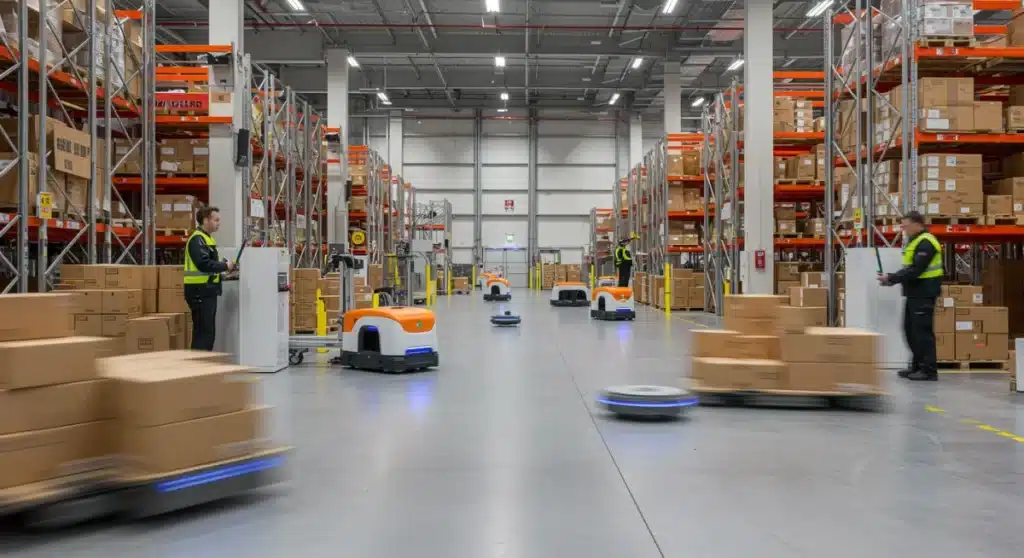
Autonomous Mobile Robots (AMRs) are at the forefront of the robotic revolution in warehousing. Unlike their AGV (Automated Guided Vehicle) predecessors, AMRs do not require fixed paths or magnetic strips. They navigate dynamically, using sensors, cameras, and sophisticated software to understand their environment, avoid obstacles, and optimize routes in real-time.
This flexibility allows AMRs to operate seamlessly alongside human workers, enhancing safety and collaboration. Their ability to adapt to changing warehouse layouts and varying workloads makes them incredibly versatile and scalable, crucial for the fluctuating demands of e-commerce.
Key applications of AMRs in fulfillment
- Goods-to-person picking: AMRs bring shelves or bins directly to human pickers, significantly reducing travel time and increasing picking efficiency.
- Inventory transport: They efficiently move items between different zones within the warehouse, such as from receiving to storage, or from storage to packing.
- Sortation and consolidation: AMRs can assist in sorting packages for specific routes or consolidating orders for shipment, streamlining the outbound process.
The deployment of AMRs drastically reduces the time spent on non-value-added activities like walking, allowing human workers to focus on more complex tasks. This synergy between human intelligence and robotic efficiency is a cornerstone of achieving faster order fulfillment and improved operational throughput.
Robotic picking and packing: Precision at speed
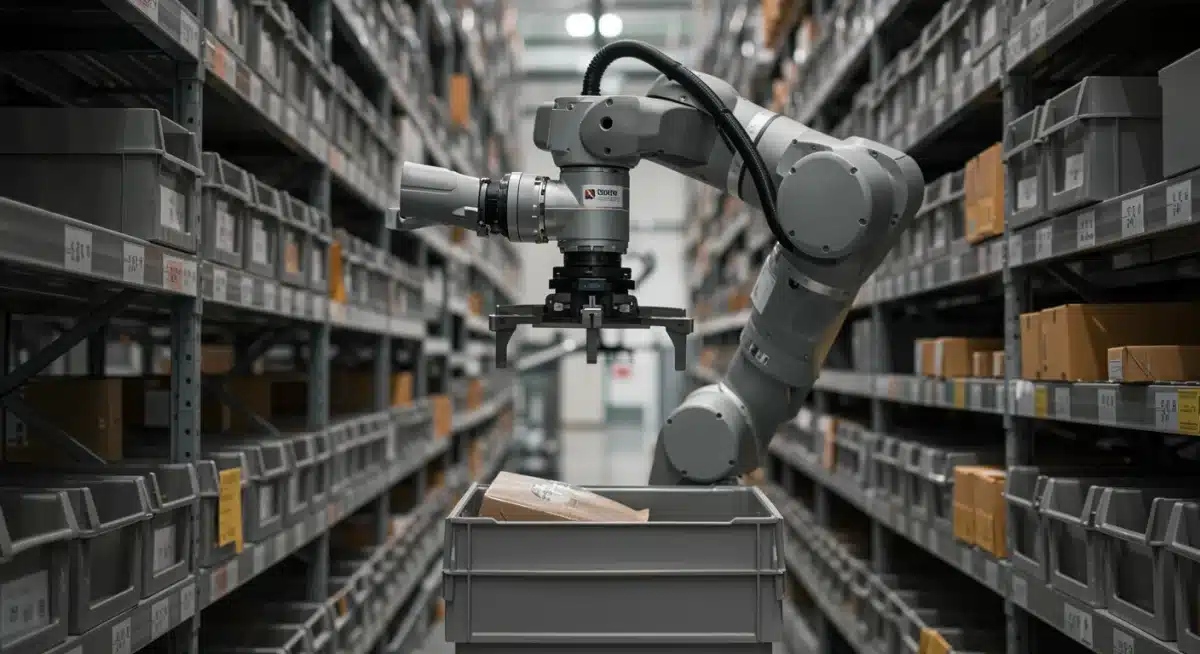
Beyond mobility, robotic arms equipped with advanced vision systems and grippers are transforming the picking and packing stages of order fulfillment. These robots can identify, pick, and place a vast array of products with remarkable speed and accuracy, overcoming the limitations of manual labor in repetitive and often ergonomically challenging tasks.
Modern robotic picking systems are no longer confined to handling uniformly shaped items. Advances in artificial intelligence and machine learning enable them to adapt to diverse product sizes, shapes, and weights, making them suitable for the varied inventory typically found in e-commerce warehouses.
Enhancing throughput and reducing errors
- Increased picking rates: Robots can operate continuously at high speeds, outperforming human pickers in sheer volume.
- Reduced picking errors: Vision systems and precise manipulation minimize mispicks, leading to higher order accuracy and fewer returns.
- Improved package density: Robotic packing can optimize carton fill, reducing shipping costs and material waste.
The integration of robotic picking and packing solutions not only accelerates the fulfillment process but also significantly enhances its reliability. By minimizing errors and maximizing throughput, these systems contribute directly to the 40% faster order fulfillment target, ensuring that products move from shelf to customer with unprecedented efficiency.
Software and AI: The intelligence behind the automation
While robots provide the physical capabilities, it is the underlying software and artificial intelligence (AI) that orchestrate their movements and decisions, unlocking the full potential of warehouse automation. Warehouse Management Systems (WMS) and Warehouse Execution Systems (WES) are evolving rapidly, integrating AI to optimize every aspect of operations.
AI algorithms analyze vast amounts of data, including historical order patterns, real-time inventory levels, and robot performance metrics, to make intelligent decisions. This includes optimizing storage locations, dynamically assigning tasks to robots, and predicting potential bottlenecks before they occur.
Optimizing the entire fulfillment workflow
Advanced AI-driven software can:
- Dynamic path planning: Constantly adjust robot routes to avoid congestion and minimize travel time.
- Predictive maintenance: Analyze robot performance data to anticipate and prevent equipment failures, ensuring continuous operation.
- Demand forecasting: Integrate with sales data to optimize inventory placement and prepare for surges in order volume.
The synergy between powerful robotics and intelligent software creates a highly responsive and adaptive warehouse environment. This allows e-commerce businesses to not only process current orders faster but also to proactively prepare for future demand, making the 40% faster fulfillment goal a tangible reality by 2025.
Challenges and considerations for adoption
The promise of robotics in warehousing is immense, but its adoption is not without challenges. Implementing these advanced systems requires significant upfront investment, careful planning, and a deep understanding of existing operational workflows. Companies must conduct thorough cost-benefit analyses to ensure a positive return on investment.
Integration with legacy systems can also be complex. Many existing warehouses operate on older infrastructure, and seamlessly connecting new robotic solutions with established WMS and ERP systems requires technical expertise and strategic foresight. Cybersecurity concerns also arise with increased connectivity and automation.
Overcoming implementation hurdles
- Scalability: Designing systems that can grow with the business and adapt to future demands.
- Workforce retraining: Investing in training programs to upskill human workers for new roles in robot supervision, maintenance, and data analysis.
- Vendor selection: Choosing robotics partners with proven track records, robust support, and flexible solutions.
Despite these hurdles, the long-term benefits of increased efficiency, reduced operational costs, and enhanced customer satisfaction often outweigh the initial challenges. Strategic planning and a phased approach to implementation can mitigate risks and ensure a smooth transition to a more automated future, driving progress towards the 40% faster fulfillment objective.
The future outlook: Hyper-automation and sustainable practices
Looking beyond 2025, the evolution of robotics in warehousing is set to enter an era of hyper-automation. This involves not just automating individual tasks but orchestrating entire workflows with minimal human intervention, leveraging advanced AI, machine learning, and the Internet of Things (IoT).
Furthermore, sustainability will play an increasingly critical role. Robotic systems, by optimizing routes and reducing energy consumption through efficient operation, can contribute to greener logistics. Reduced material waste from optimized packing and fewer mispicks also aligns with environmental goals, making operations not just faster but also more responsible.
Emerging trends and innovations
- Collaborative robots (cobots): Working even more closely with humans, performing tasks that require both precision and adaptability.
- Drone technology: Used for inventory auditing and hard-to-reach shelf inspections, enhancing accuracy and speed.
- AI-powered predictive analytics: Further refining demand forecasting and operational optimization to near-perfect levels.
The continuous advancement in robotic capabilities, coupled with intelligent software, promises a future where e-commerce fulfillment is not only remarkably fast but also highly agile, resilient, and sustainable. The 40% faster order fulfillment target by 2025 is just the beginning of a transformative journey for US e-commerce, driven by the relentless innovation in warehouse robotics.
| Key Aspect | Description |
|---|---|
| Fulfillment Speed Goal | Achieve 40% faster order fulfillment for US e-commerce by 2025. |
| Core Technology | Autonomous Mobile Robots (AMRs) for dynamic navigation and goods-to-person systems. |
| Process Enhancement | Robotic picking and packing for precision, speed, and reduced errors. |
| Driving Intelligence | AI and advanced software optimize workflows, path planning, and demand forecasting. |
Frequently asked questions about warehouse robotics
AMRs are intelligent robots that navigate warehouses autonomously using sensors and AI. Unlike older AGVs, they don’t need fixed paths, allowing them to dynamically adapt to the environment, avoid obstacles, and optimize routes for tasks like goods-to-person picking and inventory transport, enhancing efficiency and flexibility.
Robotics accelerate fulfillment by significantly reducing manual travel time, increasing picking and packing speeds, and minimizing errors. AMRs bring items to workers, while robotic arms precisely handle products. AI-driven software then optimizes these processes, from inventory placement to dynamic route planning, ensuring rapid order processing.
AI acts as the brain for robotic systems, enabling real-time optimization. It facilitates dynamic path planning, predictive maintenance, and accurate demand forecasting. This integration leads to more efficient resource allocation, fewer bottlenecks, and a highly responsive operational environment, crucial for meeting aggressive fulfillment targets.
Yes, key challenges include substantial upfront investment costs, complex integration with existing legacy systems, and the need for workforce retraining. Companies must also address cybersecurity concerns and ensure chosen solutions are scalable. Careful planning and phased implementation are vital for overcoming these hurdles successfully.
Robotics are expected to shift, rather than eliminate, jobs. Repetitive and strenuous tasks will be automated, allowing human workers to transition to roles focused on robot supervision, maintenance, data analysis, and customer service. This transformation requires investment in reskilling programs to prepare the workforce for new opportunities in automated environments.
Conclusion
The ambition to achieve 40% faster order fulfillment for US e-commerce by 2025 through robotics in warehousing is a testament to the transformative power of automation. From the dynamic navigation of AMRs to the precision of robotic picking and the overarching intelligence of AI-driven software, every component plays a crucial role. While challenges exist, the undeniable benefits in speed, accuracy, and operational efficiency position robotics as an indispensable force driving the future of retail innovation. E-commerce businesses that strategically embrace these technologies will not only meet evolving consumer demands but also establish new benchmarks for competitive advantage in a rapidly accelerating market.